Weed control
Weed control in Perth, south of the river
There is a point where a lawn stops being a lawn with some weeds in it and becomes weeds with some lawn in it. Bindii through winter, winter grass everywhere, clover and creeping oxalis in the thin patches, and paving joints full of growth by August.
We do selective, targeted weed treatment across lawns, garden beds and hard surfaces. Selective is the important word: on a lawn the aim is to take the weeds out and leave the turf, not to brown off the whole thing and start again.
Details last reviewed by the Kiss My Grass team
In short
Will weed spraying kill my lawn?
No. Kiss My Grass uses selective weed treatment, which takes the weeds out and leaves the turf, across lawns, garden beds and hard surfaces in Perth south of the river. The aim on a lawn is never to brown off the whole thing and start again.
- Selective
- Targets the weeds and leaves the lawn — not a blanket brown-off
- Where
- Lawns, garden beds, paving joints and other hard surfaces
- Common Perth weeds
- Bindii, winter grass, capeweed, clover, creeping oxalis
- Timing
- Treat while the weed is growing and before it seeds — the cooler, wetter months for Perth's winter weeds
- Visible change
- One to two weeks for most treatments; some weeds need a second pass
Where we treat
- Lawns — selective treatment
- Broadleaf and grassy weeds targeted within the lawn so the couch, kikuyu or buffalo is left standing. This is the bulk of the weed work we do.
- Garden beds and borders
- Beds treated and, where it makes more sense, weeded by hand as part of a garden clean-up. Some beds are a spray job, some are a hand job, and mixed plantings are usually the latter.
- Paths, paving and hard surfaces
- Driveways, paving joints, limestone, gravel and kerbs. This is where growth reappears fastest and where a treatment is most visible.
- Fence lines and boundaries
- The strips along fences and behind sheds that nothing gets mown and everything grows in.
- Vacant blocks and larger areas
- Follow-up treatment after block slashing, so a cut block doesn't grow straight back before the next deadline.
When to treat
Timing is most of the result with weed control. The general rule is to treat while the weed is actively growing and before it sets seed — once it has seeded, you have solved this year's problem and inherited next year's.
In Perth that makes the cooler, wetter months the important window for the winter weeds that most lawns struggle with: bindii, winter grass, capeweed and clover all germinate with the autumn rains and run through winter. Treating them early in that cycle, while they're small, is far more effective and cheaper than trying to deal with an established mat in late spring. Bindii in particular is worth getting before it forms the seed heads that make a lawn unusable barefoot.
Summer weeds and hard-surface growth are a different cycle and get treated through the warmer months. And a lawn that has just been vertimowed or cored is temporarily open, which is a moment to plan treatment around rather than ignore.
Why weeds keep winning
Weeds are opportunists — they colonise space the lawn isn't holding. That's why the same patches come back year after year: the bare, thin, compacted or shaded areas are the weakness, and spraying alone never fixes a weakness.
A lawn that's thin because the soil is compacted will keep opening up until the compaction is dealt with. A lawn that's rooting into thatch instead of soil has no vigour to compete. A lawn cut too short, or scalped, gives weeds light at soil level. And a lawn under a dense tree canopy is losing to shade, not to weeds.
So the honest version of this service is that treatment buys you a clean lawn now, and the lawn's own density is what keeps it clean. If yours keeps going back, the fix is usually a renovation — coring, vertimowing, and a sensible mowing height — rather than more spray.
How it works
- 01
Send close-up photos
Weed control is the one job where close-ups genuinely matter — identifying what's growing decides the approach. A photo of the weed itself plus a wide shot of the area. Use the enquiry form.
- 02
We quote it upfront
Priced from the area, what's growing and where it is. Often quoted alongside a mow or a clean-up, because one visit beats two.
- 03
We treat it
Applied to suit the weed and the surface, with the timing and re-entry advice you need on the day. Some weeds need a follow-up pass a few weeks later, and if so we'll tell you upfront rather than after.
Pets, kids and re-entry
Tell us in your enquiry if you have pets, chickens, kids using the lawn, or edible garden beds nearby — it changes what's appropriate and where. We'll give you clear re-entry advice on the day and we'd rather plan around it in the quote than have you find out afterwards.
Areas we service
Weed control runs across the whole southern corridor — Perth south of the river, from North Fremantle across to Belmont, out to Byford and south to Mandurah. The service areas page has the full suburb list.
Established lawns in Spearwood and Bibra Lake tend to bring the classic winter-weed problems in older couch and kikuyu. Newer lawns around Cockburn Central more often have weeds getting in through thin patches over compacted fill, which is a coring problem wearing a weed costume.
What weed control costs
Quoted from area, surface type and what's growing. Lawns, beds and hard surfaces are different jobs with different approaches, so a quote covering all three will itemise them.
Two things move the price. Extent is one: a lawn with scattered bindii is a light pass, and a lawn that is majority weed is a bigger job with a follow-up. Number of passes is the other — some weeds are one treatment, some genuinely need a second a few weeks later, and we tell you which yours is when we quote.
It's cheapest bundled onto a visit we're already making, and it's cheapest overall when it's done early in the weed's cycle rather than once it has taken the lawn.
Lawns and beds we keep clear
A dense lawn and a mulched bed are the best weed control there is. Treatment buys you a clean start; the lawn's own thickness is what keeps it.
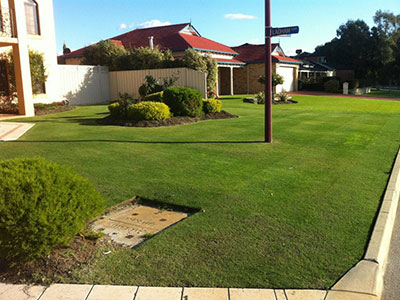
A dense corner lawn mown around established beds. 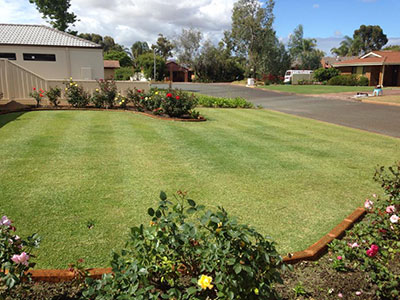
Mulched, edged rose beds with a clean lawn boundary. 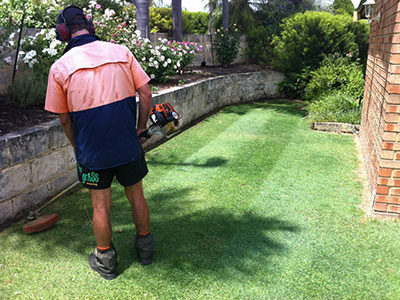
Keeping a hard edge between lawn and bed.


Weed control FAQs
Will weed spraying kill my lawn?
Not when it's a selective treatment matched to the weed and the turf type — that's the whole point of selective. Tell us whether your lawn is couch, kikuyu or buffalo if you know, because it affects what's suitable. Buffalo in particular is sensitive to products that couch tolerates fine.
How do I get rid of bindii in a Perth lawn?
Treat it early in its cycle, through the cooler months while the plants are small and well before the prickly seed heads form. Once it has seeded you've lost that round — the seed is already in the lawn for next year. This is the single most common weed enquiry we get.
How long until the weeds die off?
Most treatments show visible change within one to two weeks depending on the weed, the product and the weather. Some weeds need a second pass a few weeks later, and we'll flag that in the quote rather than surprise you with it.
Is it safe for pets and children?
Tell us about pets, chickens, kids and any edible beds when you enquire — it changes what we use and where. You'll get clear re-entry timing on the day.
Why do the same weeds come back every year?
Because they're filling space the lawn isn't holding — usually thin patches over compacted soil, a lawn rooting into thatch, mowing too short, or shade. Spraying clears them; lawn density is what keeps them out. If yours cycles back annually, coring and vertimowing will do more than another spray.
Can you treat weeds in paving and gravel?
Yes — driveways, paving joints, limestone, gravel, kerbs and fence lines. Hard surfaces are the most visible result you'll get from a treatment.
Related services
Get your weeds sorted
Send a close-up of what's growing and a wide shot of the area. We'll identify it, quote it upfront, and tell you whether it needs one pass or two.