
Lawn care advice
What is vertimowing, and does your lawn need it?
Vertimowing — also called dethatching or verticutting — is a machine that cuts vertically down through a lawn to strip out the dead thatch layer sitting between the green growth and the soil.
It is the answer to one of the most frustrating problems in Perth lawn care: a lawn you water, feed and mow properly that stays thin and patchy anyway.
Published · Updated · Written by the Kiss My Grass crew, Perth WA
In short
What is vertimowing?
Vertimowing, also called dethatching or verticutting, is a machine that cuts vertically down through a lawn to strip out the dead thatch layer sitting between the green growth and the soil. It is the fix for a Perth lawn that stays thin and patchy despite being watered, fed and mown properly.
- Also called
- Dethatching, verticutting
- What thatch is
- A dead fibrous layer between green growth and soil that stops water and nutrients getting down
- Self-test
- Cut a wedge with a spade: under 1 cm of brown layer is fine, 2 cm or more is your problem
- Best window in Perth
- Spring through early summer once the soil has warmed, or early autumn
- Never
- Mid-winter — a warm-season lawn will not recover and weeds take the open soil
- Recovery
- Two to four weeks of active growing weather
What thatch is
Thatch is the layer of dead and living stems, runners and roots that accumulates at the base of a lawn, above the soil. Every lawn has some. A thin layer, up to about a centimetre, is normal and slightly useful — it cushions foot traffic and insulates the soil surface.
Past that, it stops being a cushion and becomes a barrier. A thick thatch layer is a dense fibrous mat, and it behaves like a sponge laid over your soil.
That is the problem in one image. Water hits the sponge, spreads sideways through it, and evaporates off the surface before any of it reaches the soil. Fertiliser does exactly the same. And the grass, finding moisture in the mat rather than in the ground, roots into the thatch itself instead of into the soil — which leaves it with no depth and no drought reserve at all.
So you end up with a lawn that browns off in the first genuinely hot week of summer, recovers slowly, and looks thin no matter how much you put on it. Not because you are doing too little, but because almost none of what you are doing is getting through.
Why Perth lawns are so prone to it
Three local factors stack up, which is why thatch is close to the default condition of an established Perth lawn that has never been renovated.
The grasses. Kikuyu and couch are vigorous runner grasses — they spread by putting out stems along and just under the surface, and that is exactly the material thatch is made of. The more vigorously they grow, the faster it accumulates. Buffalo builds a coarser thatch more slowly, but it still builds it.
The season length. A long warm growing season means more months of growth per year than a cooler climate produces, so the layer builds faster.
And the care. This is the counter-intuitive part: thatch builds fastest on lawns that are well looked after. Regular water and regular feeding produce vigorous growth, and vigorous runner grass produces thatch. The lawns we see with the worst thatch layers usually belong to people who have been diligent about their lawn for a decade.
A lawn without a thatch problem
Firm underfoot, even colour, water going straight down instead of sideways. This is what you are aiming at.
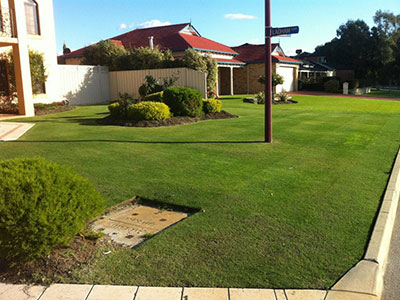
A thick, even lawn with no spongy layer underfoot. 
Close-up: dense growth sitting straight on the soil. 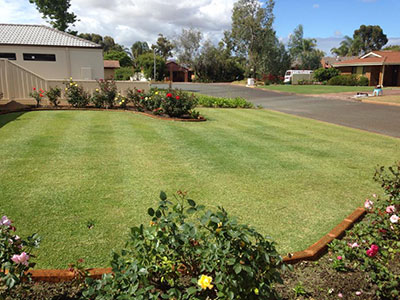
Even colour right to the bed edges.


Diagnose it yourself in two minutes
You do not need anyone to look at it. Two checks, and you will know.
- Walk on it
- A healthy lawn feels firm with a little give. A thatched lawn feels bouncy or spongy — like walking on carpet underlay. This is the single most reliable sign, and most people recognise it immediately once they know to look for it.
- Cut a wedge out with a spade
- Take a small triangular plug and look at it side-on. You will see green growth on top, brown fibrous material below it, then soil. Measure the brown layer. Under a centimetre is fine. Two centimetres or more and that is your problem, confirmed.
- Watch what water does
- Thatch: water beads and sits briefly on the surface, then disappears sideways rather than down. Dig a plug straight afterwards and you'll find wet mat over dry soil — which is the whole story in one look.
- Rule out the other one
- Compaction produces similar symptoms from the opposite cause. Hard underfoot and water running off means compacted soil, and the fix is coring. Spongy underfoot means thatch. If you're unsure, push a screwdriver into damp soil — if it's hard to get in, you have compaction too.
Lots of established lawns have both problems. That's normal, and doing both in one spring visit is what a lawn renovation is.
What the machine actually does
A vertimower runs vertical blades that cut down through the lawn into the thatch layer, slicing it up and lifting it out. It is a genuinely aggressive process — this is not a light rake.
The debris that comes out is startling. A lawn with years of build-up can produce a volume of material that looks like it cannot possibly have come from that area. Dealing with it is part of the job: when we vertimow, the thatch is collected and leaves with us the same day rather than being left in piles.
What is left behind is a lawn cut down to its runners with soil visible between them, which brings us to the part nobody warns people about.
It will look terrible, and that is correct
A freshly vertimowed lawn looks like it has been savaged — thin, brown, soil showing through. That is what removing years of accumulated thatch looks like, and everyone's first reaction is that a mistake has been made. Water it well, feed it, and give it two to four weeks of active growing weather. It comes back thicker and greener than it was. Do not vertimow in the month before a wedding, a home open or a rental inspection.
Timing, and how often
Because vertimowing deliberately takes the lawn back hard, timing is not optional. It has to be done when the grass is growing strongly enough to recover and fill back in: spring through early summer once the soil has genuinely warmed, or early autumn while real warmth remains in the ground.
Mid-winter is the wrong answer and it is worth being blunt about why. A warm-season lawn stripped back in July is not growing, so it does not recover. Cool-season weeds are growing, and they now have open soil to germinate into. You will spend the following spring dealing with a weed problem instead of enjoying a thicker lawn.
Frequency depends on how fast your lawn builds thatch. Vigorous, well-fed kikuyu may want it annually. A slower buffalo lawn might go two or three years. If the spade test shows under a centimetre, you do not need it this year.
The full renovation
Vertimowing and coring address different problems, and done together in one spring visit they are what turf people mean by a lawn renovation.
The logic of the pairing is straightforward. Vertimowing removes the barrier between water and soil. Coring opens the soil itself so water can move down into it and roots can follow. Do one without the other and you have fixed half the path.
Immediately after both is also the best moment all year to fertilise, top-dress or apply a wetting agent, because for once it will actually reach the root zone. And it is cheaper as one visit than as two — which is how most of our customers buy it.
Common questions
What is vertimowing, and does my lawn need it?
Vertimowing, also called dethatching, cuts vertically through the lawn to strip out the dead thatch layer that stops water and nutrients reaching the soil. It's why many Perth lawns stay patchy no matter how much they're watered. If your lawn feels spongy underfoot or water sits on the surface, thatch is the usual cause. We vertimow across the southern suburbs and take the thatch away the same day.
Is vertimowing the same as dethatching or verticutting?
Yes — three names for one job. Vertimowing and verticutting describe the machine cutting vertically into the lawn; dethatching describes what it achieves. 'Lawn renovation' usually means vertimowing and coring done together.
How do I know if I have thatch?
Walk on it — spongy or bouncy is the giveaway. Then cut a wedge out with a spade and look at it side-on: more than about a centimetre of brown fibrous material between the green and the soil confirms it.
How long before the lawn looks good again?
Two to four weeks of active growing weather. It looks thin and rough at first, which is expected. Water and feed it and it comes back denser than before.
When shouldn't I vertimow?
Mid-winter, when warm-season grasses can't recover and cool-season weeds will take the open space. Also not in the month before any date you need the lawn to look good.
Do I need to do it every year?
Not necessarily. Vigorous kikuyu might want it annually; a slower buffalo lawn can go two or three years. Use the spade test — under a centimetre of thatch means you can skip it.
Related
- VertimowingWhat's included, what moves the price, and the areas we cover. Thatch taken away same day.
- Lawn aeration and coringThe other half of a renovation. Bundle both in spring.
- When to aerate a lawn in PerthThe window that matters, and two tests to tell compaction from thatch.
- Lawn mowingRegular cutting slows thatch build-up.
Think you've got a thatch problem?
Send a photo of a spade wedge showing the layer and we'll tell you honestly whether it needs doing this year. Book it for spring.