
Lawn aeration
Lawn aeration and coring in Perth
If your lawn is thin, hard underfoot and water runs off it instead of soaking in, the problem is usually not the amount of water or fertiliser you're putting on. It's that neither is getting down to the roots.
Aeration — also called coring or core aeration — punches through compacted soil to open it up, so water, air and nutrients can reach the root zone again. It's one of the cheapest things you can do to a struggling lawn, and on Perth's sandy, heavily trafficked lawns it often does more than another season of feeding.
Details last reviewed by the Kiss My Grass team
In short
What does lawn aeration do, and when should it be done in Perth?
Aeration, also called coring, punches through compacted soil so water, air and nutrients reach the root zone again. Kiss My Grass cores lawns across Perth south of the river in spring, once the soil has warmed and the lawn is actively growing, or in early autumn while warmth remains in the ground.
- Also called
- Coring, core aeration
- What it fixes
- Compaction — water running off, lawn hard underfoot, thin growth despite feeding
- Best window in Perth
- Spring once the soil has warmed; early autumn as a second window
- Avoid
- Mid-winter, when a dormant warm-season lawn cannot heal the holes
- Not the same as
- Vertimowing, which removes thatch rather than relieving compaction
- Area
- Perth south of the river
What aeration actually does
Soil under a lawn compacts over time. Foot traffic, kids, pets, parked trailers, mower wheels and years of watering all press the soil particles closer together, and the air gaps between them — the spaces roots need — disappear. Compacted soil sheds water rather than absorbing it, holds less air, and forces roots to stay shallow because they can't push down.
Coring removes small plugs of soil across the lawn, which does three things at once: it creates channels for water and air to move down, it gives roots somewhere to grow into, and it relieves the pressure on the soil either side of each hole. The result is a lawn that takes water instead of shedding it, and roots that go deeper and hold on better through summer.
It also helps everything else you do work harder. Fertiliser and wetting agents applied to a compacted lawn largely sit on the surface. Applied just after coring, they go where the roots are.
Signs your lawn needs coring
You usually don't need a soil test. The lawn tells you.
- Water pools or runs off
- You water, and it beads up, sits on the surface or runs to the low side of the lawn instead of disappearing into it.
- The ground is hard underfoot
- The lawn feels solid rather than springy, and a screwdriver pushed into damp soil takes real effort to get in.
- Thin, worn patches in the traffic lines
- The path from the back door to the shed, the strip where the trailer sits, the kids' route to the trampoline — the lawn gives up in the compacted lines first.
- It stays stressed through summer no matter what
- A lawn with shallow roots has no reserve. It's the first thing to go brown in a hot week and the slowest to come back.
- Heavy clay or heavily built-up soil
- Newer estates are often built on brought-in fill that has been compacted by machinery. A lawn laid over that can struggle from day one.
If the lawn feels spongy rather than hard, and water sits on top of a soft layer, that's thatch rather than compaction — see vertimowing. The two problems look similar and the fixes are different.
When to aerate in Perth
The right window is when the lawn is actively growing, so it recovers quickly and fills the holes back in. For Perth's warm-season grasses — couch, kikuyu and buffalo — that means spring through to early summer once the soil has genuinely warmed, and early autumn while there's still warmth in the ground.
Avoid the depths of winter, when warm-season turf is barely growing and holes stay open, and avoid the hottest part of summer if the lawn is already stressed and you can't water it in afterwards.
Once a year is plenty for most home lawns. Lawns with heavy traffic, heavy soil, or a run of poor seasons behind them benefit from doing it two seasons in a row and then dropping back. If we're already visiting for lawn mowing, coring is easy to add to a scheduled visit.
How it works
- 01
Tell us about the lawn
Your suburb, the approximate lawn area, and photos of the worst of it. Mention any reticulation you know the position of. The quote form takes photos.
- 02
We quote it upfront
Priced from area and access. It's often quoted alongside vertimowing or a mow, because doing them in one visit is cheaper than separate trips.
- 03
We core it
Usually a single short visit. Water it in well afterwards, and if you're going to fertilise or apply a wetting agent, straight after coring is the best time you'll get all year.
Areas we service
Aeration is available across our whole patch — Perth south of the river, from North Fremantle across to Belmont, out to Byford and south to Mandurah. The suburb list is on the service areas page.
It's a job we do a lot of in the newer estates where lawns sit on compacted construction fill — the Atwell and Success belt and around Cockburn Central — and in established suburbs like Spearwood and Bibra Lake where lawns have simply had thirty years of traffic on them.
What aeration costs
Aeration is quoted from lawn area and access, and it is one of the better-value jobs on this site: it's a short visit, there's no green waste to cart, and the effect lasts a full season.
Access is the main variable. A front lawn a machine can be wheeled straight onto is quick. A back lawn behind a narrow gate, up steps or through a courtyard takes longer to set up than to core. Reticulation matters too — we work around heads and lines, and knowing roughly where they run speeds the job up and reduces risk.
The cheapest way to buy it is bundled. Coring plus vertimowing in one visit, or coring added to a scheduled mow, saves you a separate call-out and is how most of our regulars do it.
Lawns that take water properly
When the soil is open, the same amount of water and fertiliser goes considerably further.

Close-up of dense, even turf. 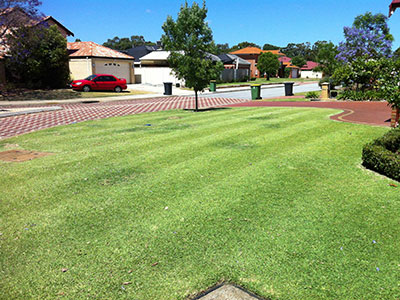
A wide front lawn holding colour through summer. 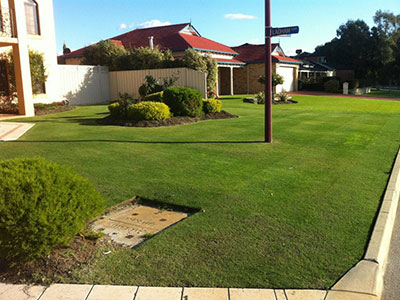
A corner lawn with no thinning in the traffic lines.


Lawn aeration FAQs
What's the difference between aeration and coring?
In practice they're used interchangeably. Strictly, aeration is any process that gets air into the soil, and coring is the specific method of removing small plugs of soil — which is what we do, because it relieves compaction properly rather than just spiking holes in it.
When is the best time to aerate a lawn in Perth?
While the lawn is actively growing so it heals fast: spring into early summer once the soil has warmed, or early autumn. Avoid mid-winter, when warm-season grasses aren't growing, and avoid the peak of summer if the lawn is already stressed.
How often should I have it done?
Once a year suits most home lawns. Lawns with heavy foot traffic, compacted fill soil, or a couple of poor seasons behind them are worth doing two years running before dropping back to annual.
Will it damage my lawn?
No, if it's done in the growing season. The lawn looks freckled with small plugs for a week or two and then closes over. That's why timing matters — done in mid-winter the holes just sit there.
What should I do straight after coring?
Water it in well. If you were planning to fertilise, top-dress or apply a wetting agent this season, immediately after coring is the most effective time to do it, because it goes down the holes to the root zone instead of sitting on the surface.
What about my reticulation?
We work around sprinkler heads and lines. If you know roughly where yours run, tell us or mark the heads — it makes the job quicker and lowers the risk of catching something.
Related services
- VertimowingThe other half of a lawn renovation — strips out thatch rather than relieving compaction.
- Lawn mowingAdd coring to a scheduled mow and skip a separate visit.
- Weed controlA thin, compacted lawn is where weeds get in. Worth treating together.
- Garden clean-upsBeds, hedges and green waste while we're on site.
Get your lawn cored
Tell us your suburb and roughly how big the lawn is. We'll quote it upfront, and it's cheaper bundled with vertimowing or a scheduled mow.