
Vertimowing
Vertimowing and dethatching in Perth
If your lawn feels spongy underfoot, water sits on the surface before disappearing, and it stays patchy no matter how much you water and feed it — you almost certainly have a thatch problem, not a watering problem.
Vertimowing cuts vertically down through the lawn to strip out that dead thatch layer. It looks brutal on the day and it is the single most effective thing you can do for a tired Perth lawn. We take the thatch away the same day, so you're not left with a yard full of debris.
Details last reviewed by the Kiss My Grass team
In short
What is vertimowing, and does my lawn need it?
Vertimowing, also called dethatching or verticutting, cuts vertically down through a lawn to strip out the dead thatch layer between the green growth and the soil. Kiss My Grass vertimows across Perth south of the river and takes the thatch away the same day.
- Also called
- Dethatching, verticutting
- Symptoms
- Spongy underfoot, water sitting on the surface, lawn patchy despite watering and feeding
- Self-test
- Cut a wedge with a spade: under 1 cm of brown fibrous layer is fine, 2 cm or more is a thatch problem
- Best window in Perth
- Spring through early summer once the soil has warmed, or early autumn — never mid-winter
- Recovery
- Two to four weeks of active growing weather
- Thatch
- Removed and taken away the same day
What thatch is, and why Perth lawns get it
Thatch is the layer of dead and living stems, runners and roots that builds up between the green growth on top and the soil underneath. A thin layer is normal and even useful — it cushions the lawn. Once it gets thick, it turns into a mat that behaves like a sponge sitting on top of your soil.
That mat is the problem. Water hits it, spreads sideways through it and evaporates before it ever reaches the soil. Fertiliser does the same. The grass responds by rooting into the thatch itself rather than into the ground, which leaves it with no drought reserve at all — so the lawn browns off in the first hot week and never quite recovers.
Perth's most common lawn types are the ones most prone to it. Kikuyu and couch are vigorous runner grasses that build thatch quickly, especially when they're well fed and well watered. Buffalo builds a coarser thatch more slowly but builds it. Add a long growing season and years of regular watering, and a thick thatch layer is close to the default state of an established Perth lawn that has never been renovated.
This is why so many people conclude their lawn is beyond help after a couple of seasons of feeding and watering harder. They're feeding and watering a sponge.
Signs your lawn needs vertimowing
- It feels spongy or bouncy underfoot
- The clearest sign. A healthy lawn feels firm with a little give. A thatched lawn feels like walking on carpet underlay.
- Water sits on the surface, then vanishes
- Water beads and pools briefly, then disappears sideways rather than down. Dig a small plug and you'll find dry soil under a wet mat.
- A visible brown layer in a cross-section
- Cut a wedge out with a spade. If there's more than about a centimetre of brown fibrous material between the green and the soil, that's your answer.
- Patchy no matter what you do
- Thin, uneven colour that doesn't respond to fertiliser, because the fertiliser isn't reaching the roots.
- The mower scalps easily
- A thick thatch layer makes the surface uneven and soft, so the mower sinks in places and shaves the lawn back to brown.
Spongy and soft is thatch. Hard and shedding water is compaction — see lawn aeration and coring. A lot of lawns have both, and the two jobs are usually done together.
When to vertimow in Perth
Timing matters more for this job than for anything else we do, because vertimowing deliberately takes the lawn back hard. It has to be done when the grass is growing strongly enough to recover and fill back in, which for warm-season grasses means spring through to early summer once the soil has properly warmed.
Early autumn can work while there's still real warmth in the ground. Mid-winter is the wrong time: a warm-season lawn taken back in July will sit there thin and open, and weeds will get the space before the grass does. Peak heat is also poor timing if the lawn is already stressed.
Once every year or two is right for most lawns, depending on how fast yours builds thatch. Vigorous, well-fed kikuyu might want it annually; a slower buffalo lawn might go two or three years.
How it works
- 01
Send photos and the lawn area
Photos of the lawn, and if you can, a photo of a cut wedge showing the thatch layer thickness. Plus your suburb and roughly how big the area is. Use the quote form.
- 02
We quote it upfront
Priced from area, thatch depth and access. Most people bundle it with coring, and often with a mow, because one visit is cheaper than three.
- 03
We vertimow and take the thatch away
The machine cuts down through the lawn, the debris is collected, and it leaves with us the same day. Expect the lawn to look thin and shocking for a fortnight — that's normal and it is the job working.
Four to six weeks after a renovation
Thin and shocking for a fortnight, then thicker and greener than it was. This is the far end of that.
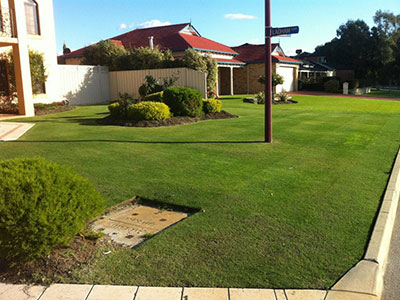
A thick, even lawn once the thatch is gone. 
Dense growth sitting straight on the soil. 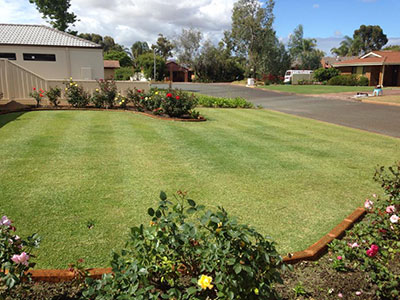
Even colour right to the bed edges.


It looks worse before it looks better
A freshly vertimowed lawn looks like it has been attacked. That is what removing years of thatch looks like. Water it well, feed it, and expect two to four weeks of active growing weather before it thickens back up — greener and denser than it was. If you need the lawn looking good for a specific date, do not vertimow in the month before it.
Areas we service
Vertimowing is available right across Perth south of the river, from North Fremantle across to Belmont, out to Byford and south to Mandurah. Full list on the service areas page.
The lawns that need it most are the established ones — decades of kikuyu and couch growth on the mature streets of Spearwood and Bibra Lake, and the older parts of the Fremantle flank. Newer turf around Cockburn Central is usually a few years off needing it, and those lawns tend to want aeration first.
What vertimowing costs
Quoted from lawn area, how deep the thatch is, and access. Thatch depth is a real cost factor: a lawn with a thin layer is one straightforward pass, and a lawn with years of build-up produces a genuinely large volume of debris to collect and cart, sometimes across more than one pass.
Access follows the same logic as every other machine job — a front lawn is quicker than a back lawn behind a narrow gate.
Bundling is where the value is. Vertimowing and coring together, in the right season, is a proper lawn renovation and it is much cheaper as one visit than two. Adding it to a scheduled mow saves a trip again.
Vertimowing FAQs
What is vertimowing, and does my lawn need it?
Vertimowing, also called dethatching, cuts vertically through the lawn to strip out the dead thatch layer that stops water and nutrients reaching the soil. It's why many Perth lawns stay patchy no matter how much they're watered. If your lawn feels spongy underfoot or water sits on the surface, thatch is the usual cause. We vertimow across the southern suburbs and take the thatch away the same day.
Is vertimowing the same as dethatching or verticutting?
Yes — different names for the same job. Vertimowing and verticutting describe the machine cutting vertically into the lawn; dethatching describes what it achieves. Lawn renovation usually means vertimowing and coring done together.
How long does the lawn take to recover?
Two to four weeks of active growing weather. It will look thin and rough at first — that's expected. Water it well and feed it, and it comes back thicker than before.
When is the best time of year to vertimow in Perth?
Spring through early summer once the soil has warmed, or early autumn while there's still warmth in the ground. Don't do it in mid-winter: warm-season grasses won't recover and weeds will take the open space.
Do you take the thatch away?
Yes, the same day. Vertimowing produces a lot of debris and it goes with us, included — you don't need a verge collection or a skip.
Should I vertimow or aerate?
Spongy and soft means thatch, so vertimow. Hard and shedding water means compaction, so core. Many established lawns have both, and doing them together in one spring visit is the standard lawn renovation.
Related services
- Lawn aeration and coringThe other half of a renovation. Bundle both in one spring visit.
- Lawn mowingRegular cutting keeps thatch building more slowly.
- Weed controlA freshly opened lawn is vulnerable — worth planning treatment around it.
- What is vertimowing, and does your lawn need it?A longer read on diagnosing thatch yourself before you book anything.
Get your lawn vertimowed
Tell us your suburb and lawn size and we'll quote it upfront. Book it for spring, and bundle it with coring for a full renovation.