
Blog
Lawn and garden advice for Perth
Most lawn advice online is written for a climate that is nothing like ours — cool-season grasses, summer rainfall, soil that holds water. Applied to a kikuyu lawn on Perth sand it is somewhere between useless and actively wrong.
These are the questions we get asked most often on the job, answered for Perth conditions and Perth grasses. No sign-up, no course, no upsell — if the answer is that you do not need us, that is what it will say.
Details last reviewed by the Kiss My Grass team
In short
Where can I get lawn advice written for Perth conditions?
The Kiss My Grass blog answers the lawn questions the crew is asked most on the job, written for Perth conditions: warm-season grasses on sand, dry summers, winter rain. Most lawn advice online assumes cool-season grass and summer rainfall, and applied to a Perth lawn it is often actively wrong.
- Written for
- Perth conditions — kikuyu, couch and buffalo on sandy soil
- Written by
- The Kiss My Grass crew, from jobs across Perth south of the river
- Topics so far
- Mowing frequency, aeration timing, vertimowing and thatch, firebreak season
- Cost
- Free to read — no sign-up, no course, no email capture
Latest articles
- How often should you mow a lawn in Perth?Why the answer changes by season and grass type, the one-third rule that stops a lawn being scalped, and what actually happens when you skip three weeks in December.
- When is the best time to aerate a lawn in Perth?The window that matters for warm-season turf, how to tell compaction from thatch with a screwdriver and a spade, and why coring beats another bag of fertiliser.
- What is vertimowing, and does your lawn need it?How to diagnose thatch yourself in two minutes, why well-watered Perth lawns stay patchy, and what the lawn looks like for the fortnight afterwards.
- When is firebreak season in Cockburn and Kwinana?The deadline in each council, what 50 mm across the property means, and why a slashed strip is not always a firebreak.
Why Perth is different
Three things set lawn care here apart, and almost every piece of generic advice ignores at least one of them.
The grasses are warm-season. Couch, kikuyu and buffalo grow hard when the soil is warm and go quiet when it is cold. Every timing decision — mowing, coring, vertimowing, feeding — follows that cycle, which is the reverse of the cool-season calendar most online guides assume.
The soil is sand. It drains fast, holds little water and holds even less nutrient. Water and fertiliser move through it rather than sitting in it, so the useful question is rarely how much you are applying and almost always whether it is reaching the root zone.
And the water is regulated. Perth has seasonal sprinkler restrictions and a winter sprinkler ban set by the state, so you cannot simply water your way out of a problem even if you want to. Which makes getting the soil and the thatch right the only real lever you have.
Perth lawns we look after
Real jobs from across the southern suburbs. Everything below is a lawn on a regular cycle, not a one-off showpiece.
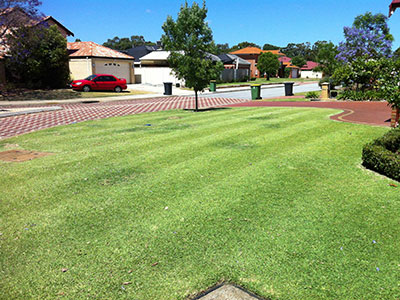
A wide front lawn kept on a fortnightly cycle. 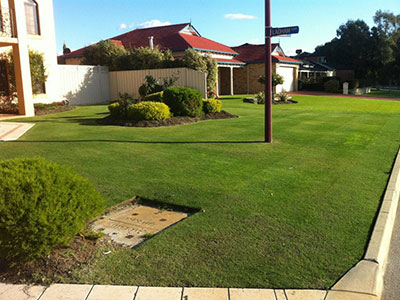
A dense corner lawn mown around established beds. 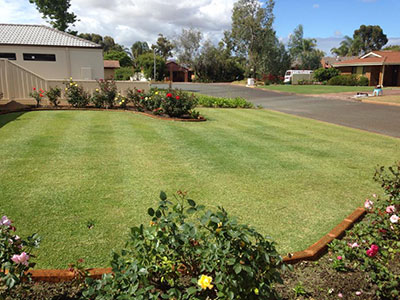
Timber-edged borders holding a clean lawn line.


What's coming next
The topics we're working through, each written to answer a question we get asked on the job rather than to hit a keyword. If you want one of these sooner, tell us and we'll bump it.
- How much does stump grinding cost?
- Why nobody can quote a stump over the phone, the two factors that decide the price, and the one measurement to take before you enquire. Supports stump grinding.
- Signs a tree needs pruning or removal
- The contact, safety and practical signals worth acting on before a storm rather than after one — and what needs council approval first. Supports tree services.
- How to clean up an overgrown garden
- Where to start, what order to do it in, what's worth saving, and the point at which it's cheaper to get a crew in. Supports garden clean-ups.
- How to prepare an overgrown block for sale
- What buyers and valuers actually look at, why a block you can walk photographs completely differently, and how far ahead to book. Supports block slashing.
- A lawn care calendar for Perth homeowners
- One page covering what to do to a warm-season lawn in each season — mowing height, feeding, coring, vertimowing and weed timing, in order.
- Bindii: getting rid of it for good
- Why treating it in spring is already too late, the window that works, and what makes it come back every single year in the same patches. Supports weed control.
Who writes this
The crew that does the work — Kiss My Grass has been mowing, renovating and clearing yards across Perth's southern suburbs since 2010, and everything here comes out of doing the job rather than out of a content brief.
That also means we will tell you when you do not need us. Several of these articles end with a test you can do yourself with a spade and a screwdriver, and if the answer is that your lawn is fine, that is the answer. We would rather be the business you call in three years because we were straight with you now.
Or skip the reading
If you already know what the job is, go straight to it.
Still not sure what your lawn needs?
Send a photo and describe the problem. We'll tell you what the job actually is — often it's cheaper than people expect, and sometimes it's nothing.