
Lawn care advice
How often should you mow a lawn in Perth?
The short answer: every seven to fourteen days through the warm months, and every two to four weeks through winter. But the useful answer is that frequency is not really the thing to decide. How much you take off is.
Published · Updated · Written by the Kiss My Grass crew, Perth WA
In short
In short
Every seven to fourteen days through Perth's warm months, and every two to four weeks through winter. The more useful rule is how much you take off rather than how often: never remove more than a third of the leaf in one cut, which is what actually sets the interval.
- Warm months
- Every 7–14 days
- Winter
- Every 2–4 weeks
- The rule that matters
- Never cut more than one third of the leaf blade in a single pass
- Fastest growers
- Kikuyu and couch once the soil warms; buffalo is slower but still gets away in summer
- Clippings
- Catching or mulching is a separate decision from interval
The rule that actually matters
Turf managers call it the one-third rule: never remove more than about a third of the leaf height in a single cut. Break it and the lawn does not just look bad, it goes backwards.
Here is why. Grass feeds itself through its leaves. Take a third off and the plant has plenty left to keep photosynthesising, so it recovers in days. Take two-thirds off and you have removed most of its food factory in one hit — the lawn goes pale or brown, the plant burns stored energy from the roots to rebuild leaf, and while it is doing that it stops growing roots. A lawn scalped repeatedly ends up shallow-rooted, thin, and far more vulnerable to a hot week in February.
Cutting a long lawn short also exposes the pale, unphotosynthetic lower stems that had been shaded, and opens the soil surface to light — which is an invitation to every weed seed sitting in it.
So the practical framing is: mow often enough that a normal cut is only ever taking off a third. Once you have that, the calendar sorts itself out.

Perth's seasons, and what they do to growth
Our common lawn grasses — couch, kikuyu and buffalo — are all warm-season types. They grow hardest when the soil is warm and effectively idle when it is cold, which makes growth here strongly seasonal rather than steady.
Through the peak growing months, roughly October to March, a well-watered kikuyu or couch lawn can put on real length in a week. This is when weekly mowing genuinely earns its keep, and where fortnightly starts to push the one-third rule on a lawn that is thriving.
In the shoulder seasons — early spring and autumn — growth is moderate and fortnightly suits most lawns comfortably.
Through the cold months, warm-season turf slows right down and can stop growing more or less entirely. Every two to four weeks is plenty, and mowing a dormant lawn hard does it no favours. What winter does bring is weeds, because they are cool-season and they are growing while your lawn is not — which is why a lawn can look worse in August despite needing less mowing.
By grass type
All three want the same principle applied at slightly different heights and intervals.
- Couch
- The fastest to look untidy and the one that suits the shortest cut. Weekly in peak growth, fortnightly in the shoulders. Couch handles a low height well and thickens when cut regularly, but it thatches quickly if you feed and water it hard.
- Kikuyu
- The most vigorous of the three by a wide margin. Weekly in summer or it will get away from you, and it is the grass most often scalped because people underestimate a fortnight of December growth. It also builds thatch faster than anything else here.
- Buffalo
- Slower and best kept longer — buffalo does not tolerate being cut short the way couch does, and scalping it is a genuine setback. Fortnightly usually suits it, with a longer blade height than you would use on couch.
If you don't know which you have: couch has fine, soft leaves; kikuyu has broader leaves and thick, obvious runners; buffalo has wide, coarse, folded leaves.
Mowing interval, by grass type and season
Read it as a starting point, then check it against the one-third rule on your own lawn — a shaded back lawn and a full-sun front lawn on the same block can sit a week apart.
| Grass type | Peak growth (Oct–Mar) | Shoulder (Apr–May, Sep) | Winter (Jun–Aug) | Cutting height |
|---|---|---|---|---|
| Couch | Weekly | Fortnightly | Every 2–4 weeks | Lowest of the three — thickens when cut short and often |
| Kikuyu | Weekly | Fortnightly | Every 2–4 weeks | Low to mid — the one most often scalped after a skipped cycle |
| Buffalo | Fortnightly | Fortnightly | Every 2–4 weeks | Highest of the three — cutting it short is a real setback |
Winter intervals are the same across all three because warm-season turf is barely growing — there is simply nothing to take off. The differences show up in summer, and so does the damage from getting it wrong.
What skipping three weeks in December actually costs
This is the most common way a good lawn gets damaged in Perth, and it usually happens over Christmas.
Three weeks of peak-season kikuyu growth means the next cut cannot obey the one-third rule at any sensible height. If you take it back to where it was, you scalp it — brown patches, exposed stems, and a lawn that looks worse after being mown than before. If you leave it long, you have accepted a taller lawn and you now need to bring it down in two or three staged cuts a week apart.
The staged approach is the right one. It is also more work and more visits, which is why a skipped cycle costs more than the mow you skipped. And a scalped lawn in January is entering the hottest part of the year with reduced leaf and shortened roots — the worst possible timing.
If your lawn has already got well past the point where staged cuts will fix it, that is not a mowing job any more. A garden clean-up resets it, and a normal cycle picks up from there.
When mowing more often is not the answer
Sometimes a lawn looks poor and the mowing schedule has nothing to do with it. Two patterns come up constantly.
If the lawn feels spongy underfoot and water sits on the surface before disappearing sideways, you have a thatch layer — and no mowing frequency fixes that. Vertimowing does.
If the ground is hard underfoot and water runs off rather than soaking in, the soil is compacted, the roots are shallow and the lawn has no reserve. Coring is the fix.
Both of those get misread as needing more water, more fertiliser or more mowing. If your lawn is thin despite a sensible cycle, check for those two before you change anything else.
Edging and detail work
The part that decides whether a lawn looks cut or looks finished — included in every mow.
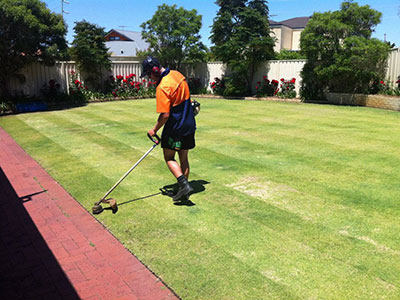
Whipper-snipping the edges of a striped back lawn. 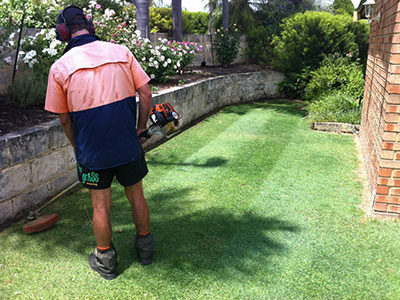
Cutting a clean edge along a limestone garden wall. 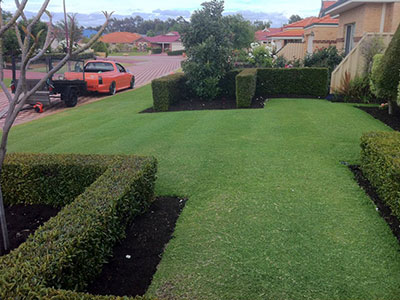
Low hedges and mulched beds around a freshly mown lawn.


Common questions
How often should I mow my lawn in Perth in summer?
Weekly for kikuyu and couch that are being watered, fortnightly at the outside. Buffalo can usually go fortnightly. The test is whether a cut takes off more than about a third of the leaf height — if it does, you're mowing too infrequently.
How often in winter?
Every two to four weeks. Warm-season grasses barely grow when the soil is cold, so there's little to take off, and cutting a dormant lawn hard doesn't help it.
What happens if I mow too short?
You remove most of the leaf the plant feeds itself with, so it burns root reserves to rebuild, stops growing roots, goes pale or brown, and opens the soil surface to weed seed. Repeated scalping produces a shallow-rooted lawn that struggles every summer.
Should I catch the clippings or leave them?
Light clippings from a regular cut can be left and will break down, returning some nutrient. Heavy clippings from an overdue cut should come off — a thick layer of cuttings smothers the lawn and adds to the thatch layer. When we mow, clippings leave with us either way.
Is fortnightly mowing enough?
For most Perth lawns most of the year, yes — and it's what the majority of our regulars run. In peak summer growth on a well-watered kikuyu lawn, weekly is better. Most of our customers hold a fortnightly cycle and let us tighten or stretch it with the season.
Want us to hold the cycle for you?
Most of our customers sit on a fortnightly mow and let us adjust it with the season, so it never gets to the scalping stage. Free quote, no callout fee.