
Lawn care advice
When is the best time to aerate a lawn in Perth?
Spring, once the soil has genuinely warmed and the lawn is actively growing — or early autumn while there is still warmth in the ground. That is the window, and the reason is simple: aeration works by making holes, and you want a lawn growing fast enough to heal them.
Published · Updated · Written by the Kiss My Grass crew, Perth WA
In short
In short
Spring, once the soil has genuinely warmed and the lawn is actively growing, or early autumn while there is still warmth in the ground. Aeration works by making holes, so the lawn has to be growing fast enough to heal them. Coring a dormant Perth lawn in winter leaves the holes open.
- Best window
- Spring, once the soil has warmed and growth has started
- Second window
- Early autumn, while real warmth remains in the ground
- Avoid
- Mid-winter — a dormant warm-season lawn cannot close the holes
- Aeration vs vertimowing
- Coring relieves compaction; vertimowing removes thatch — different problems
- Frequency
- Depends on traffic and soil, not on the calendar
Why timing decides whether it works
Coring removes small plugs of soil from the lawn. Immediately afterwards you have a lawn full of open holes and a scattering of plugs on the surface. Whether that ends well depends entirely on how fast the grass grows into it.
In active growth, warm-season turf closes those holes over within a couple of weeks, and the channels left behind become permanent routes for water, air and roots. That is the whole point.
Do it in mid-winter, when couch, kikuyu and buffalo are dormant or close to it, and nothing happens. The holes sit open. The lawn does not thicken. What does grow is cool-season weeds, which are actively growing at exactly that moment and now have bare, open soil to germinate into. You have aerated the lawn and seeded a weed problem.
So the rule is: core when the grass is winning, not when the weeds are.
The Perth calendar
- Spring, once the soil has warmed — the best window
- Growth is accelerating, there is a whole season of warmth ahead, and the lawn has time to establish deeper roots into the new channels before summer heat arrives. If you only do it once a year, do it here.
- Early autumn — the second-best window
- Still enough warmth in the soil for real recovery, and it sets the lawn up going into winter. Better than late spring if you missed the first window.
- Peak summer — only with care
- Possible, but only if the lawn is healthy and you can water it in properly afterwards. Coring an already heat-stressed lawn adds stress at the worst time.
- Mid-winter — don't
- Warm-season turf isn't growing, the holes stay open, and cool-season weeds take the space. This is the single most common way aeration gets wasted.
What a lawn with a working root zone looks like
Dense, even, and able to hold on through February — the result of water and nutrient actually reaching the roots.

Close-up of even, healthy turf. 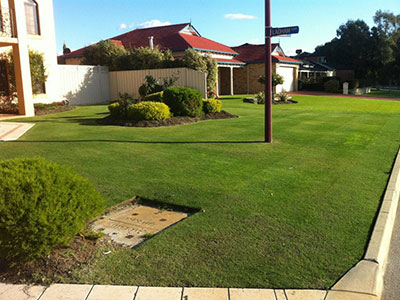
A thick corner lawn with no thinning in the traffic lines. 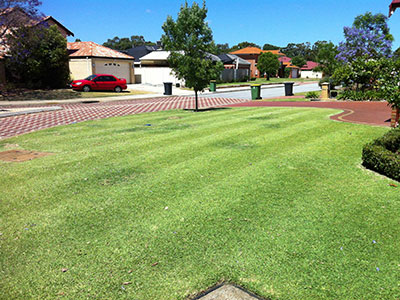
A large front lawn holding colour right to the kerb.


Is it actually compaction? Two tests
Before you book anything, work out which of the two common problems you have — because compaction and thatch look almost identical from a distance and need opposite treatments.
The screwdriver test, for compaction. Water the lawn, wait an hour, then push a long screwdriver into the soil. In healthy soil it goes in with light hand pressure. If you have to lean on it, or it stops after a couple of centimetres, the soil is compacted and coring is your answer.
The spade test, for thatch. Cut a wedge out of the lawn and look at it side-on. Between the green growth and the soil you will see a brown fibrous layer. Under about a centimetre is normal. Much more than that and you have a thatch problem, which needs vertimowing, not coring.
The quick version, without tools: hard underfoot and water runs off means compaction. Spongy underfoot and water sits then vanishes sideways means thatch. Plenty of established lawns have both, in which case do both in one spring visit — that is what a lawn renovation is.
Compaction or thatch? Side by side
Both make a lawn thin, and both get blamed on the reticulation. The tests tell them apart in a couple of minutes.
| How you check | Compaction — needs coring | Thatch — needs vertimowing |
|---|---|---|
| Feel underfoot | Hard and solid, especially when dry | Spongy and springy, like walking on carpet underlay |
| What water does | Runs off or pools on the surface | Sits, then disappears sideways without wetting the soil |
| Screwdriver test | Stops after a centimetre or two, or needs you to lean on it | Goes in normally once through the fibrous layer |
| Spade test — cut a wedge, look side-on | No thick brown layer; the soil itself is dense | A brown fibrous layer well over a centimetre thick above the soil |
| Best time to treat it | Spring once the soil has warmed; early autumn second best | Spring once the soil has warmed, so the lawn can regrow into it |
| The treatment | Coring — plugs of soil removed | Vertimowing — thatch cut out vertically |
Plenty of established Perth lawns tick both columns. That is not a problem to choose between — it is a lawn renovation, and both are done in the one spring visit.
Signs your lawn needs coring
- Water runs off or pools
- Rather than soaking in. The clearest single sign, and the one most often blamed on the reticulation.
- Hard underfoot
- The lawn feels solid rather than springy, especially when dry.
- Worn traffic lines
- The path to the shed, the strip where the trailer parks, the kids' route to the trampoline — compaction shows in the traffic lines first.
- It browns off first every summer
- Shallow roots mean no drought reserve, so it's the first to go and the slowest to come back.
- New estate turf that never thrived
- Lawns laid over rolled construction fill start compacted. Very common in the newer suburbs, and often misread as a bad batch of turf.
Why coring beats another bag of fertiliser
This is the part that changes how people spend money on their lawn.
Fertiliser applied to a compacted lawn largely stays near the surface, and on Perth sand a good deal of what does move goes straight past the root zone. The nutrient is not the constraint — delivery is. Applying more of it does not fix a delivery problem.
Coring changes the delivery. Water goes down the channels instead of running off. Air reaches the root zone. Roots have somewhere to grow into and go deeper, which is what builds actual drought tolerance rather than the appearance of it.
Which is why the sequence matters more than the products: core first, then feed. Fertiliser and wetting agents applied immediately after coring go down the holes to where the roots are, and the same bag does considerably more. Doing it the other way round is why people conclude their lawn is beyond help after three seasons of feeding.
How often, and what to do afterwards
Once a year suits most home lawns. Lawns with heavy foot traffic, compacted fill, or a couple of poor seasons behind them are worth doing two years running before dropping back to annual. There is little point coring twice in one season.
Straight afterwards: water it in well. Then, if you were going to fertilise, top-dress or apply a wetting agent at any point this season, do it now — this is the most effective window you will get all year. Keep traffic light for a week or two while the holes close.
The plugs on the surface can be left to break down, or raked and removed if you want it tidier. Neither choice makes much difference to the outcome.
Common questions
When is the best time to aerate a lawn in Perth?
Spring, once the soil has warmed and the lawn is actively growing, or early autumn while there's still warmth in the ground. Avoid mid-winter, when warm-season grasses aren't growing and cool-season weeds take the open holes.
What's the difference between aeration and coring?
They're used interchangeably in practice. Strictly, aeration is any process that gets air into soil; coring is the specific method of removing small plugs, which relieves compaction properly rather than just spiking holes into it. Coring is what we do.
Should I aerate or vertimow?
Hard underfoot and shedding water means compaction, so aerate. Spongy underfoot with water sitting on the surface means thatch, so vertimow. Many established lawns have both and are best done together in one spring visit.
Will coring damage my lawn?
Not if it's done in the growing season. The lawn looks freckled for a week or two and then closes over thicker than before. Done in mid-winter, the holes just sit there — which is the real risk, not the coring itself.
How often should a Perth lawn be cored?
Annually for most lawns. Two years running if it's heavily trafficked, sitting on compacted fill, or recovering from a bad run — then back to annual.
Can I core it myself?
You can hire a machine, and for a small lawn that's reasonable. The two things that catch people out are reticulation — knowing where lines and heads run — and getting the plugs deep enough to actually relieve compaction rather than just dimpling the surface.
Related
- Lawn aeration and coringWhat's included, what moves the price, and the areas we cover.
- VertimowingThe other half of a renovation — for thatch rather than compaction.
- What is vertimowing?How to diagnose a thatch layer yourself in two minutes.
- Lawn mowingAdd coring to a scheduled mow and skip a separate visit.
Book coring for this spring
Tell us your suburb and roughly how big the lawn is. Bundled with vertimowing it's a full renovation, and one visit costs less than two.